3.5.11

The Next Big Thing: New Superfoods

CupuacuIf you love expanding your nutrition horizons get ready for a whole new crop of superfoods bound to become the next big thing:

Skyr: This Icelandic yogurt is technically a soft cheese, but its texture and nutrients are similar to Greek yogurt, and it includes the same basic ingredients: skim milk and live active cultures. Skyr is made using a centuries-old straining processes that removes the whey (liquid), which makes it creamy and thick (stick a spoon in it and turn it upside down – it won’t fall out!) without providing any fat. A single 6 oz container of plain, nonfat packs 17 g of protein compared to about 15 g in Greek and 8 g in traditional yogurt.

Teff Whole grains: these grains have been white hot for the past few years but the most recent trend is ‘what’s old is new again’ and teff is an ancient grain that fits the bill. This African whole grain is used to make spongy Ethiopian flatbread. It’s known for its sweet, molasses-like flavor and its versatility; it can be cooked as an oatmeal alternative, added to baked goods or made into “teff polenta.” It packs twice the iron of other grains and three times the calcium.

Cupuaçu: Finding the next obscure fruit with a high nutrient profile is big business. Some such as pomegranate, goji berry and açai have enjoyed serious staying power, while others have been more fleeting. Experts predict that cupuaçu will be the next to test its trendiness. This creamy-fleshed, distinctly flavored fruit related to cacao grows in the Amazon and is known for its high levels of antioxidants. Its juice tastes like pear with a hint of banana.

Black Garlic: Free from additives and preservatives, black garlic is made from whole garlic that’s been aged for a month in a special fermentation process under high heat, where it develops its darker color, softer texture and sweeter taste. It’s been shown to pack twice as many antioxidants as raw garlic and because it’s soft you can easily spread it on whole grain bread or crackers. It’s sweet and delicious and won’t give you garlic breath like its unfermented cousin!

Chia Seeds: These small oval seeds pack more heart and brain saving omega-3 fatty acids than flax seeds, don’t go bad as quickly, and have been shown in research to lower blood pressure and inflammation, a known trigger of premature aging and disease. Just one Tbsp provides 5 g of fiber, about twice as much as golden flaxseed. Whip some into a smoothie – just be prepared for gel-ish texture since these gems soak up about 12 times their weight in fluid.

Online Game: Let’s Have Fun!

happy onlineOnline game has so many varieties and liked by so many people in various age. People from all over the world play online games these days, old and young, men and women, from all line of work, people just love online game, there are huge selections of online game, to name few of them are strategic games, educational games to free slots. We can choose any online game we like even from that we also can meet new friends who are fond with the same games.

Online game may increase not only our happiness level but players' creativities as well. With so many online games out there, those who are new with online game may think that they may get lost once they enter to the online game, but thanks to the internet system these days, you won’t! For each type of game, player will find rating website. This type of website provides rating; they sort only the best websites within the specific type, for instance, for those who love to play casino they can find rating website focuses on no deposit bonus codes.

Payment is also made easy these days. With the internet, you can use credit cards and paypal and other types of payment. If you don’t want to use credit cards to play online casinos then you can visit paypal casinos. Online game is a huge success these days; it provides entertainment within its simplest form. Pick games you like most and start playing, have fun and relax!

30.4.11

Kate remembers William's name

Prince William and KateThe curse is broken! Kate remembered William's full name! It might sound like a small victory, but it's far from it. William's full name is quite a mouthful. For the record, he is William Arthur Philip Louis. Imagine trying to remember that with two billion people watching.

The bride also wore white. Chris Jackson/Getty Images In royal weddings past, Princess Diana and Princess Sarah Ferguson messed up when asked to recite their groom's full name. According to Dickie Arbiter, former press secretary to the queen, Diana mixed up the order of Charles's names.

Diana had a pretty good excuse: Charles's full name is Charles Philip Arthur George. Same deal with Fergie; she accidentally repeated Prince Andrew's middle name. Not so with Kate. She nailed William's full name. A good omen if ever there was one.

24.4.11

Apple iPhone Secretly Records Owners' Every Move

Security researchers have discovered that Apple's iPhone keeps track of where you go - and saves every detail to a secret file on the device which is copied to the owner's computer when synchronised.

The file contains the latitude and longitude of the phone's recorded coordinates along with a timestamp, meaning that anyone who stole the phone or the computer could discover details about the owner's movements using a simple program.

For some phones, there could be almost a year's worth of data stored, as the recording of data seems to have started with Apple's iOS 4 update to the phone's operating system, released in June 2010.

20.4.11

NASA Posted Thousands of Incredible Space Images on The Internet

NASA space imageYou'll go starry-eyed at Nasa’s latest mission success - because the space agency has uploaded thousands of amazing space snaps onto the internet, including shots of previously unseen galaxies, stars and asteroids.

The colossal gallery – available to anyone with a connection to the web - was taken by Nasa’s super hi-tech sky-mapping telescope.

It took a staggering two and a half million pictures of the universe, which include 33,000 new asteroids found floating between Mars and Jupiter – and 20 comets.

Since 2009 the £200million infrared telescope, called the Wide-field Infrared Survey Explorer, or WISE, has been scanning the cosmos with the most sophisticated cameras ever deployed in space.

Its lenses can pick up heat glow, so are able to find dusty, cold and distant objects that are invisible to normal telescopes.

Among the eye-opening images released by Nasa is one of the Comet Siding Spring, seen streaking across the sky with a ghostly trail and the gigantic Andromeda galaxy, which lies 2.5million light-years from Earth. WISE also snapped the stunning rose-shaped Berkeley 59 cluster of young stars, burning away in their stellar nursery.

12.4.11

Introducing World's First Facebook Bullying Alert System

Facebook Bullying Alert Systemwhat a concerned father can do when he want to stop abusive behavior such as bullying? He developed the world's first bullying alert system for Facebook! NHS consultant Paddy Clarke's software scans walls and inboxes for trigger words and phrases such as 'gay' and 'fat' and alerts parents when they appear. The father-of-four came up with the idea after reading a string of cyber-bullying horror stories.

Mr Clarke, 48, said he hoped his system - called 'Know Diss' - will keep children safe from online bullies. He said: 'Bullying has now gone from the playground into children's homes. 'Kids feel safe sending an abusive message in their rooms. It is pretty awful.

'Cyber-bullying is very topical at the moment, particularly following some tragic cases where young people have taken their lives because of it. 'It is hard to believe but this software is the only one in the world to search through text on social networking sites to protect children.

'Know Diss is a very simple concept. It is also a partnership between parent and child because one cannot sign up without the other.' Mr Clarke, a consultant in pain relief at Gloucestershire Royal Hospital in Gloucester, joined forces with friend Alan Saul to design and implement Know Diss, which costs £12 for a yearly subscription.

4.4.11

Laptop energy saving: hibernate, sleep, or shut down?

energy savingHere are expert tips on how to keep your computer running smoothly: It is never fun to have to consistently wait any amount of time if the shut downs are too frequent. Sleep’ requires more power, but it boots up faster, while ‘Hibernate’ uses less power, but takes longer to come online, that same logic applies to shutting off your computer completely.

Your computer will become obsolete before you wear out your computer by turning it on and off a lot. It also doesn't take more energy to start a computer than to keep it running.

Sleep mode requires a constant, though reduced use of power (0-6 watts). Colorful screensavers do nothing to conserve energy. Accessing your computer remotely with the Wake on LAN feature also can drain the power.

To get the most for your money, expert advises adjusting power settings so that it automatically goes into Sleep/Standby mode after about 15 minutes of inactivity, and then shut it down at the end of your day.

26.3.11

Apple's iPad 2 Hits Overseas Stores after U.S. Sellout

apple logoCustomers lined up outside Apple stores in Australia and New Zealand last week for the international launch of the iPad 2, which has flown off the shelves in the United States leaving the company struggling to meet demand.

Analysts forecast some 1 million devices may have been sold in the first weekend of the launch in the United States, but many warn that it’s not clear how supply constraints will affect availability following the Japan earthquake and tsunami.

Apple plans to roll out the new iPad on Friday to 25 markets including France, the United Kingdom, Canada, Denmark, Germany, Italy, Mexico, Netherlands, and Spain. The iPad 2, a thinner and faster version that features two cameras for video chat, was introduced in the United States on March 11.

But some would-be buyers have expressed frustration at how difficult it has been to secure one of the wildly popular tablet computers, sparking speculation Apple misjudged demand.

“If it wasn’t for the iPad, I wouldn’t be in Australia right now,” said Alex Lee, a backpacker from Canada, who was the first in the queue outside the glass-fronted Apple store in Sydney’s central business district.

He said he diverted his travels from Singapore to attend the launch. “It’s like a habit. I’ve also lined up on Regent Street in London for the iPhone”, added Lee, who had a folding chair and blanket and had spent two nights waiting.

23.3.11

Are We Too Reliant on GPS?

GPSIt is an issue that many law enforcement agencies and governments don't want to discuss, according to Professor Andrew Dempster, a specialist in satellite navigation signal processing and receiver design.

The problem? Australia and the world's reliance on global navigation satellite systems (GNSS), commonly known to many as GPS, and its vulnerability to be deliberately jammed or unintentionally interfered with.

"There is ... [a] group of people (users) who don't want to talk about it," said the professor, who works at the UNSW School of Surveying and Spatial Information Systems.

"They don't want to draw attention to the fact that GPS can be jammed. They don't want people to know that it's vulnerable. And included in that group are all the major telcos, some of the authorities that track vehicles and I imagine that the police are the same – that they don't talk about it that much."

Critical infrastructure that can be impacted by interference can include plane and airport navigation systems, emergency service vehicles, ships and security vans, some of which carry large amounts of money. Researchers in Britain have gone as far as saying that GPS failures could lead to "loss of life".

One known example of an airport and planes landing there being impacted by unintentional interference has already occurred in the US, the professor said.

According to The Economist, a driver who passed the Newark airport in New Jersey each day had a GPS jammer installed in his truck for personal reasons. The Economist said it took two months in late 2009 for investigators to track down the problem, which led to "brief daily breaks in reception."

18.3.11

More Facts about St. Patrick

St. Patrick's DayReliable sources said that over the past 24 hours, Web searches for "st. patrick" and "who was st. patrick" have both tripled. Add to that the related searches on "was st. patrick really irish" and "did st. patrick get rid of all the snakes in ireland."

Here now are some quick answers to those questions and more.

Did St. Patrick rid Ireland of snakes?
Sorry, but no. It is true that there are no snakes in Ireland these days, but there never were any. National Geographic explains that because Ireland is surrounded by chilly waters, there is no way snakes could migrate there in the first place. National Geographic speculates that the snakes could be symbolic of the "pagan ways" that St. Patrick drove out of Ireland.

Was St. Patrick Irish?
According to History.com, St. Patrick was actually born in Britain. At the age of 16, he was captured by Irish raiders and transported across the sea to Ireland. After spending six years in captivity, Patrick escaped, traveled back to Britain, and trained to become a priest. Once his training was complete, he returned to Ireland "to minister to Christians already living in Ireland and to begin to convert the Irish."

Did Patrick use clovers while preaching?
Legend says that he did. Catholic.org writes that Patrick used a three-leafed shamrock to explain the Holy Trinity to the locals. However, other sites call this story just a myth. And, by the way, a bit of trivia regarding four leaf clovers. They are indeed rare, but they aren't exactly one in a million. It is estimated that there is one four leaf clover for every 10,000 three-leaf ones.

Tsunami killed thousands of seabirds at Midway

Tsunami Killed BirdsThousands of seabirds were killed when the tsunami generated by last week's massive earthquake off Japan flooded Midway, a remote atoll northwest of the main Hawaiian islands, a federal wildlife official said recently.

At least 1,000 adult and adolescent Laysan albatross were killed, along with thousands of chicks, said Barry W. Stieglitz, the project leader for the Hawaiian and Pacific Islands National Wildlife Refuges.

Many drowned or were buried under debris as waves reaching 5 feet high rolled over the low-lying atoll about four hours after the magnitude-9.0 earthquake struck Friday.

The white-and-black feathered Laysan albatross is not in danger of becoming extinct. About 1 million of the birds live at Midway Atoll National Wildlife Refuge about 1,300 miles northwest of Honolulu, making it the largest Laysan albatross colony in the world.

But Stieglitz said the deaths could account for a significant share of Laysan albatross chicks hatched during the current season.

Japan’s earthquake shifted balance of the planet

EarthLast week's devastating earthquake and tsunami in Japan has actually moved the island closer to the United States and shifted the planet's axis.

The quake caused a rift 15 miles below the sea floor that stretched 186 miles long and 93 miles wide, according to the AP. The areas closest to the epicenter of the quake jumped a full 13 feet closer to the United States, geophysicist Ross Stein at the United States Geological Survey told The New York Times.

The world's fifth-largest, 8.9 magnitude quake was caused when the Pacific tectonic plate dove under the North American plate, which shifted Eastern Japan towards North America by about 13 feet (see NASA's before and after photos at right). The quake also shifted the earth's axis by 6.5 inches, shortened the day by 1.6 microseconds, and sank Japan downward by about two feet. As Japan's eastern coastline sunk, the tsunami's waves rolled in.

Why did the quake shorten the day? The earth's mass shifted towards the center, spurring the planet to spin a bit faster. Last year's massive 8.8 magnitude earthquake in Chile also shortened the day, but by an even smaller fraction of a second. The 2004 Sumatra quake knocked a whopping 6.8 micro-seconds off the day.

12.3.11

Japan's quake toll set to exceed 1,000

Japan TsunamiA devastating tsunami triggered by the biggest earthquake on record in Japan looked set to kill at least 1,000 people along the northeastern coast on Friday after a wall of water swept away everything in its path.

The government warned there could be a small radiation leak from a nuclear reactor whose cooling system was knocked out by the quake. About 3,000 residents in the area some 240 km (150 miles) north of Tokyo had been moved out of harm's way.

Underscoring grave concerns about the Fukushima plant, the U.S. air force delivered coolant to avert a rise in the temperature of its nuclear rods, but officials said a leak was still possible because pressure would have to be released.

The unfolding disaster in the wake of the 8.9 magnitude earthquake and 10-meter (33-feet) high tsunami prompted offers of search and rescue help from 45 countries.

9.3.11

NASA says 'no support' for claim of alien microbes

aliensTop NASA scientists said there was no scientific evidence to support a colleague's claim that fossils of alien microbes born in outer space had been found in meteorites on Earth.
The US space agency formally distanced itself from the paper by NASA scientist Richard Hoover, whose findings were published Friday in the peer-reviewed Journal of Cosmology, which is available free online.

"That is a claim that Mr Hoover has been making for some years," said Carl Pilcher, director of NASA's Astrobiology Institute.

"I am not aware of any support from other meteorite researchers for this rather extraordinary claim that this evidence of microbes was present in the meteorite before the meteorite arrived on Earth and and was not the result of contamination after the meteorite arrived on Earth," he told AFP.

"The simplest explanation is that there are microbes in the meteorites; they are Earth microbes. In other words, they are contamination."

Pilcher said the meteorites that Hoover studied fell to Earth 100 to 200 years ago and have been heavily handled by humans, "so you would expect to find microbes in these meteorites."

3.3.11

The World's Smallest Computer

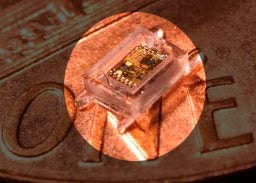
World's Smallest ComputerScientists have created the world's smallest computer system to help treat glaucoma patients. At just one square millimetre in size, the tiny device is a pressure monitor that is implanted in a person's eye.

It may be small but it packs a hefty punch, containing an ultra low-power microprocessor, a pressure sensor, memory, a thin film battery, a solar cell and a wireless radio with an antenna that can transmit data to an external reader device.

Developed by researchers at the University of Michigan, the unnamed unit - which is expected to be commercially available in several years - is already being touted as the future of the computing industry.

Its creators - Professors Dennis Sylvester, David Blaauw and David Wentzloff - claim that as the device's radio needs no tuning to find the right frequency it could link to a wireless network of computers.

A network of such units could one day track pollution, monitor structural integrity, perform surveillance, or make virtually any object smart and trackable, according to the scientists.